
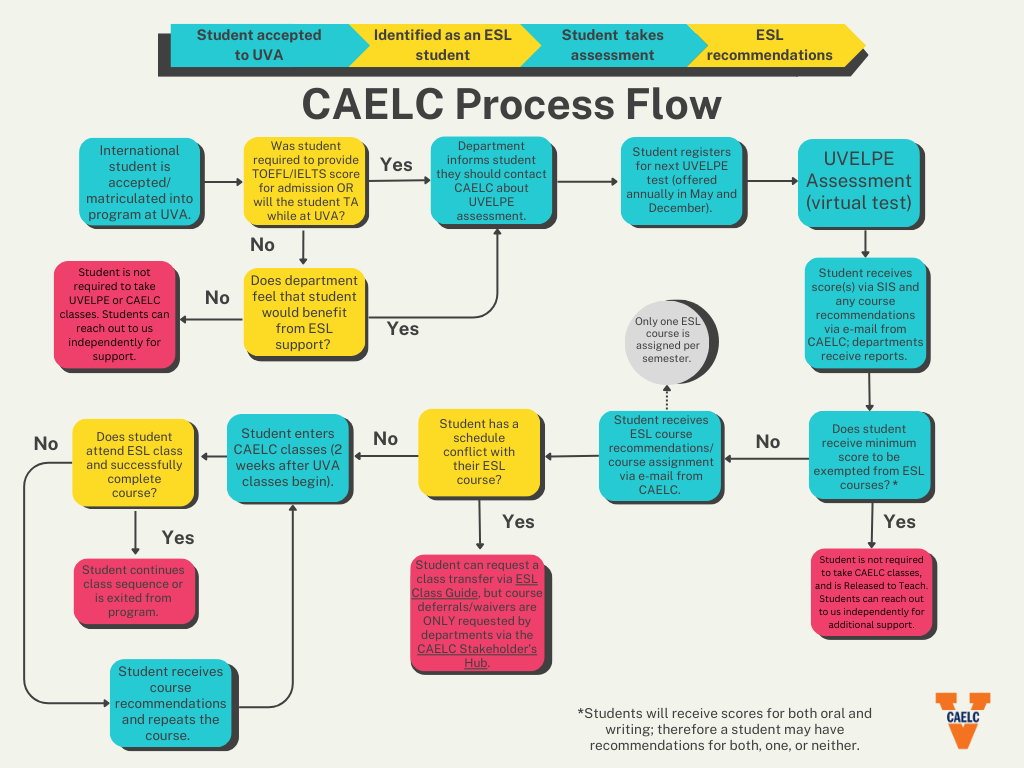
On this page, you can find answers to frequently asked questions about CAELC and its services. Please reference this page if you have questions. Also, take a look at our flow chart below about how students move through services at CAELC.
What is the difference between the UVELPE oral section and the UVELPE written section?
Please note: As of August 2020, the full University of Virginia English Language Proficiency Exam (UVELPE) will include the SPEAK Test (now called the UVELPE oral section). CAELC will continue to offer the UVELPE oral section as a stand-alone option for all students not required to take the full UVELPE. This includes potential teaching assistants who were waived from submitting a TOEFL or IELTS score.
The full UVELPE (written and oral) is a test of writing, grammar, and oral English that is required for all international students upon entry to the University. This full test is used by CAELC and UVA to recommend international students for the appropriate level of writing and oral English classes. The test has three portions, an online open-ended writing section (45 minutes), an online multiple-choice grammar and vocabulary section (45 minutes), and an oral SPEAK interview (45 minutes). Students do not need to study or prepare for this test. This test satisfies the current graduate requirement for all prospective international TAs that need the UVELPE oral section.
The stand-alone UVELPE oral section is a test of oral English proficiency that is used by CAELC and UVA to determine whether a prospective international Teaching Assistant possesses the linguistic and cultural proficiency required to teach in a US classroom using American English. This test is used to recommend the appropriate level and sequence of oral English classes for ITAs (international Teaching Assistants), if needed. Students answer a series of prompts on a variety of topics while being recorded. Students do not need to study or prepare for this test. This stand-alone section of the test is only offered to prospective international TAs who were not required to take the full UVELPE Test.
Students can access UVELPE information here.
School administrators can learn more about the UVELPE here.
Can students be exempted from the UVELPE?
There are no exemptions from the UVELPE oral section. If a student's first language is one other than English, the test is required.
Students are exempted from taking the full UVELPE if they were not required to submit TOEFL scores with their application to the University. However, departments can still require students to take the UVELPE if they would like the student to enroll in ESL classes.
How do departments/students know if a student is Released to Teach (RTT)?
There are two ways students can be RTT:
1. If a student scores a 55 or higher on the UVELPE oral section, they are Released to Teach.
2. If a student has successfully completed the highest level oral class ESL 911 (Classroom Communication: Teaching and Preparing for the Job Market), they are Released to Teach (RTT). You can find more information about ESL 911 here.
In some cases, the student's ESL instructor may recommend that he/she enroll in ESL 912 (Classroom Communication for International Teaching Assistants II) for additional support while performing TA duties. ESL 912 is not a course with a regular meeting pattern. It is an independent course in which a student Teaching Consultant (supervised by the Academic Director) observes the ITA's course and subsequently debriefs with him/her. As part of ESL 912, the ITA will also have regular meetings throughout the semester with the director of the International Teaching Assistant program. You can find more information about ESL 912 here.
What is the difference between NFOT and RTT?
NFOT: Students who receive No Further Oral Training (NFOT) in their recommendations for the semester are not recommended for any further oral classes. A recommendation of NFOT can result from the UVELPE or from completing a course at a high level. This recommendation simply means that the student does not, in the view of CAELC, require any further oral English support to study at the University. However, NFOT does not automatically mean a student is Released to Teach (RTT).
RTT: This designation means that students have either successfully completed ESL 911 or scored a 55 or higher on the UVELPE oral section.
What types of English as a Second Language (ESL) classes are there and what is the sequencing?
CAELC offers writing and oral communication classes. More information and specific course descriptions can be found on our Courses page here.
ESL writing courses (ESL 901 and 902) are not always sequenced, and students can be recommended for either course or both courses. These two courses focus on different aspects of the writing process; ESL 901 focuses on local structural aspects of written English such as grammar and sentence structure, whereas ESL 902 focuses on global aspects of written English such as organization and argumentation.
ESL oral courses (ESL 905, 907, 909, and 911) are sequenced from lower to higher proficiency, and students typically progress through these courses up through 909 or 911. ESL 917 is focused specifically on pronunciation training and is thus not part of the sequence of oral courses.
We typically place students in only one ESL course per semester given their graduate school course load.
Can CAELC defer or waive recommended courses for students?
No. CAELC manages the language proficiency exam, and then recommends them for courses but does not have the authority to defer courses to a subsequent semester or waive courses. Students must direct all deferral and waiver questions to their departments and Directors of Graduate Study.
Can students enroll themselves in CAELC ESL classes via SIS?
No. Because students are placed in CAELC ESL classes based on recommendations from test scores or previous class completion, CAELC enrolls students in their recommended courses in SIS. This happens approximately four weeks after the start of UVA classes, so students should not be concerned if their ESL classes do not show up in SIS for the first several weeks of the semester.
Where can departments/students find a schedule of ESL classes?
The schedule of ESL courses for the current semester can be found by logging in to Student Information System (SIS) here and searching under subject: ESL. Please keep in mind that some sections of classes are restricted to students from specific schools.
Do you accept visiting scholars into your department?
Unfortunately, CAELC is not a stand-alone department at UVA, and we do not offer or assign scholar positions for the University. If you are interested in being a visiting scholar, we suggest that you contact the department or school you are interested in to find out more information.
Will my scores on TOEFL or another language assessment test be enough for admission into UVA?
We do not set the language requirements for admission into the University. Each individual UVA school has their own set of requirements for admission, and you must consult with the school you wish to apply to in order to find out if your scores meet their requirements.
I live in the Charlottesville area but I'm not a UVA student or affiliate. Can I take ESL classes?
The Lorna Sundberg International Center will occasionally offer English classes for dependents, visitors, and members of the local community. Please visit the International Center website for more information. We also recommend checking Piedmont Valley Community College (PVCC) website for their English course offerings.